
From Con to Collier’s: An Early MacKenzie Short Story
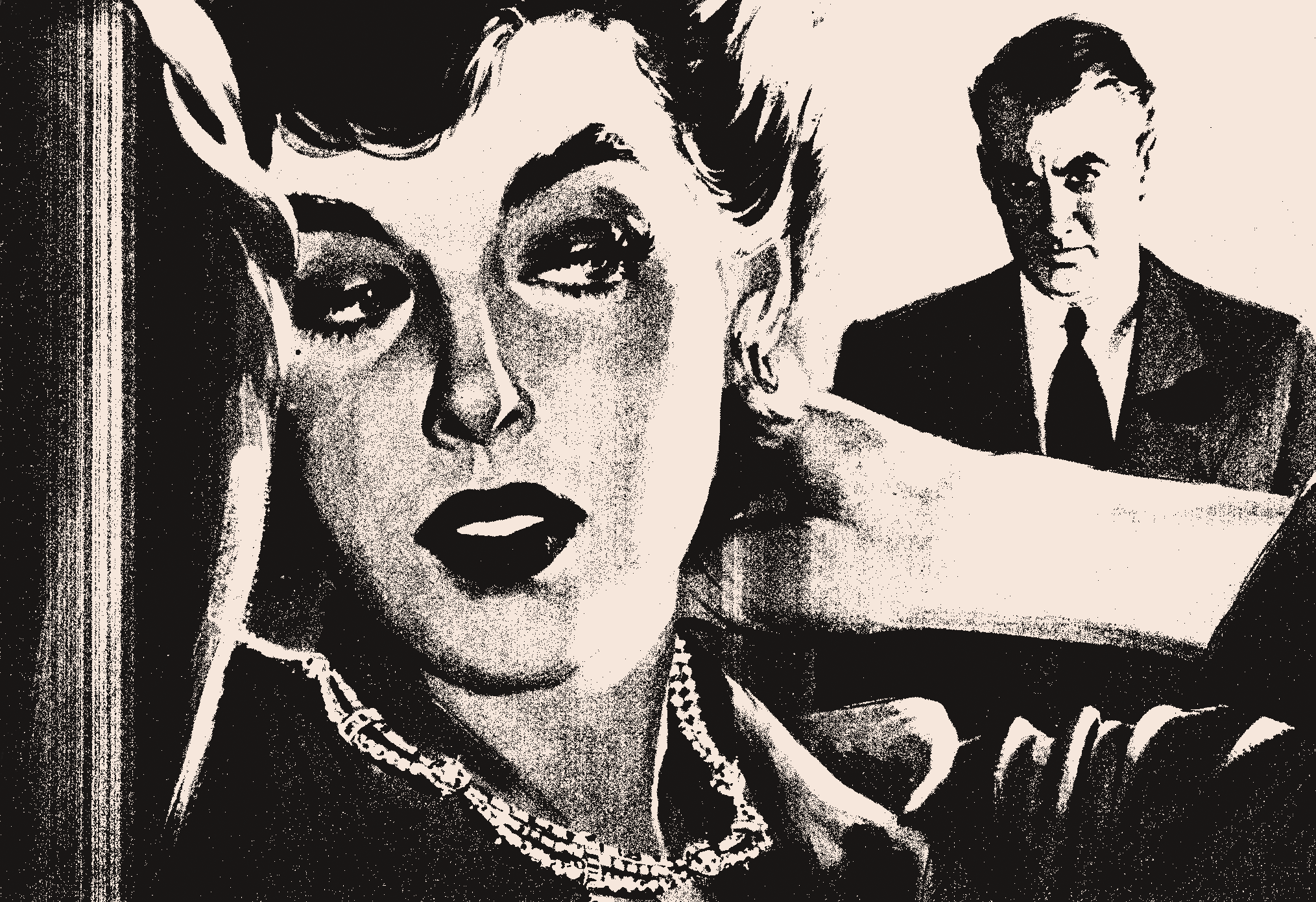
With his first published story – “Inside Call” – in Collier’s in 1952, Donald MacKenzie was inspired by one of the cons he regularly pulled in 1930. The original artwork is by Lionel Gilbert, who was a favorite illustrator for Collier’s in the 1950s.
Turning lived experience into fiction is never simple — especially when such experience includes deception, arrest and hard labor. The fiction writer must reshape memory into something credible that connects with readers, satisfies an editor’s commercial instincts, and is mindful of the moral expectations of the day.
Donald MacKenzie grappled with that dilemma in letters from his cell in Auburn State Prison to his literary agent Henry Volkening. In autumn 1950, he asked whether there might be a way the Manhattan-based agent could “conceivably pass judgement just on ideas” that he had for stories? He believed he had wasted enough time and effort writing complete drafts of stories that were, for many reasons, unsuitable. He put it awkwardly to Volkening, “I confess that I don’t know what a commercial idea is too well”.
Volkening wasted no time in responding. He would gladly look at MacKenzie’s story ideas and tell him what he thought. But he cautioned the apprentice writer:
However, I’m against it, for a reason I’ve mentioned before. I have a theory that every writer does best what he most wants to do, and that in his choice of subjects for stories, he should only be sensibly guided in not facing unnecessary odds by his excluding those ideas which are either unusually difficult for him, or which happen to violate one or another of the well-known taboos.
Claiming not to know what Volkening meant by “well-known taboos,” the unrepentant convict fired back a few days later:
Well-known to whom? I’m familiar with the more obvious ones. The sort of things that mayn’t be discussed with propriety in the bosom of the lower middle-class family. Sexual aberrations, evil triumphant and virtue unrewarded. Oh, and the rest of the attacks on their hypocritical dreariness. I’m not worried about taboos so much as ideas. Conceivably one may have a lousy idea for a story and yet not be offending any of the tribal arcana.
He was on a roll, and more sardonic jousting might have followed. Instead, he softened his tone, opening up to his agent in a more candid manner, writing from his heart in an unexpected way:
I don’t think you realize my greatest trouble, Henry, although I’ve spoken of it before. I’m quite serious about it. My views on people and on life are necessarily colored by the sort of life I’ve lived. It would be hypocrisy of the worst type and sheer ingratitude were I to tell you that I believe in the ‘eternal verities’ beloved of the readers of most magazines.
And so, if I write from the heart – to use a misnomer – I can write factually about certain aspects of life, yet they will always fail to be fully convincing. Because I’m handicapped by the necessity of squaring everything in the story with what is called a moral.
How often the con worked is anyone’s guess. At some point, though, it didn’t. He was caught, tried and sentenced. Society rights a wrong and the moral code of the day remains intact.
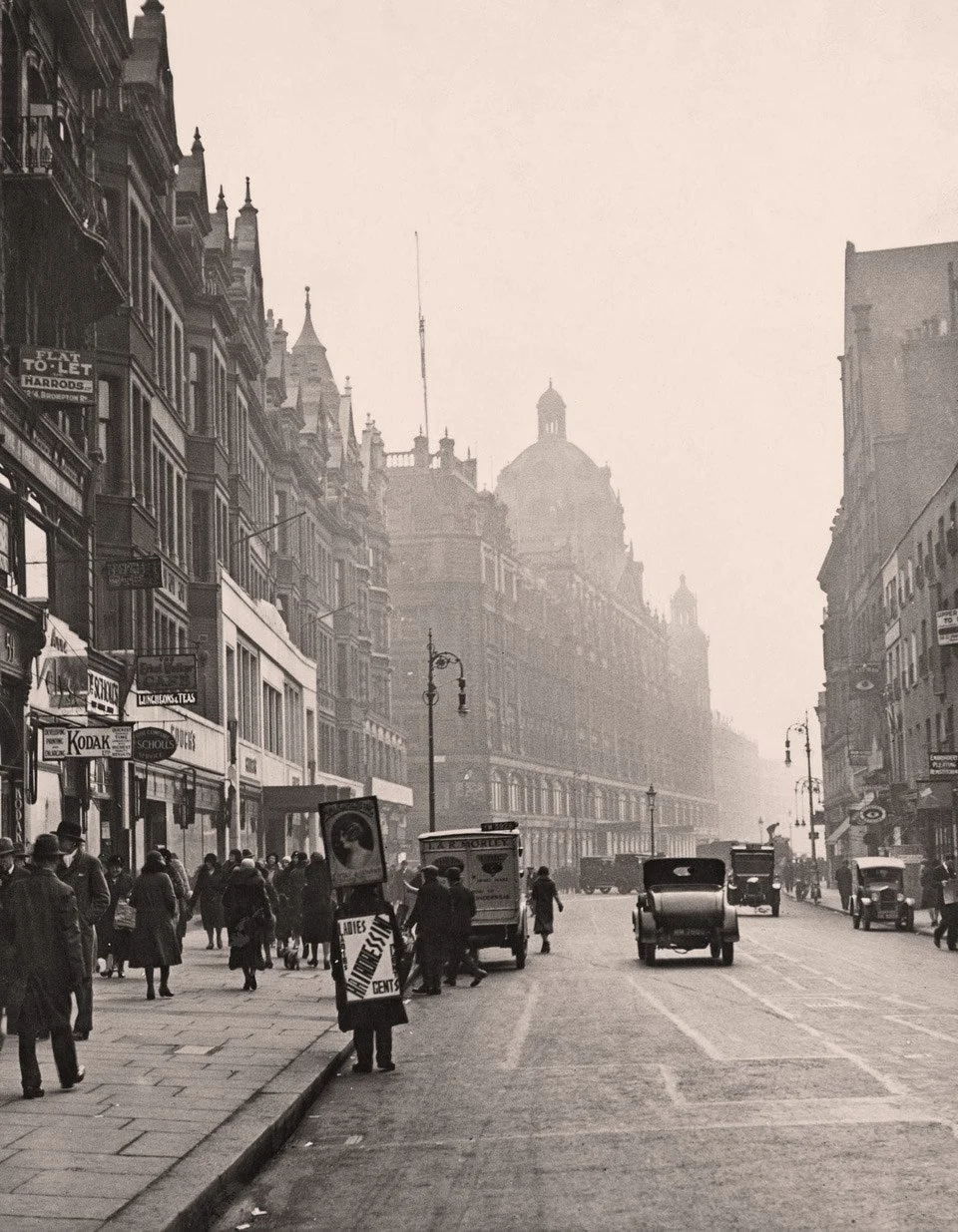
Harrods in 1930 (center building, with dome) was not merely a shop but a credit institution wrapped in marble and terracotta. Families of means held established accounts; purchases were routinely “put to account,” and goods dispatched by uniformed messenger. It was an environment built on reputation and procedure — precisely the sort in which the young MacKenzie’s scheme could flourish.
One of the ironies of MacKenzie’s complaints about the “eternal verities” – the moral standards required in popular mid-century fiction he seemed determined to buck – is that too often his experience as a criminal was getting caught. While he griped about having to square everything in the story with a moral, that is what happened to him, thanks to his many arrests, convictions and incarcerations – at least for the crimes for which he was apprehended.
A case in point is MacKenzie’s modus operandi described in the UK Registry of Habitual Criminals published in London in the late 1930s by the British Criminal Records Office. His misdeeds are described tersely but with some tantalizing details. He would reserve a room at a large, first-class West End hotel in London, “…where he posed as the private secretary to a lady of considerable means, a distant relative. He then systematically victimized local tradesmen (mostly jewelers) with whom the lady had an account, by ordering goods, purporting to be on her behalf, directing same to be delivered to the hotel where, he stated, his mistress was in temporary residence, owing to extensive decorations being carried out at her townhouse.”
How often that worked is anyone’s guess. At some point, though, it didn’t. He was caught, tried and sentenced. Society rights a wrong and the moral code of the day remains intact.
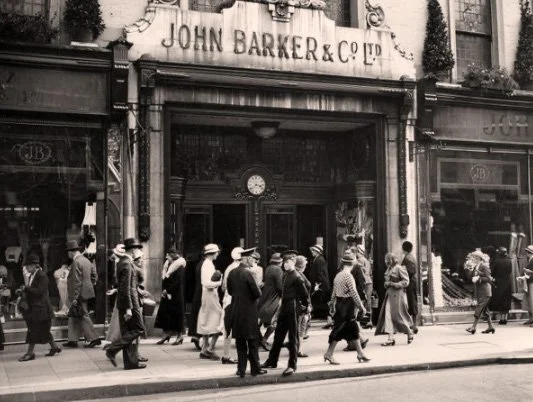
John Barker & Co. Ltd. proved equally fertile ground for MacKenzie’s ruse. He understood the retailer’s social credit structure and the conventions of West End trade. Whether he or his female companion placed the telephone call, the tone was assured, the impersonation convincing, and the confidence complete within these elite commercial spaces.
In one case, reported in several newspapers in August 1930, the twenty-one-year-old MacKenzie was charged with obtaining by false pretenses – at Barker & Co. Ltd. on High Street in Kensington and at Harrods in Knightsbridge – various articles of jewelry worth £40 (roughly US $4,400 to $4,600 today, a nice day’s work.) The article continued:
Evidence was given that the accused called at Harrods Stores on July 11th with a woman and chose a lady’s gold wristlet watch. He asked that the purchase should be placed to the credit of his aunt and that the watch should be sent to the Hotel Splendide, Piccadilly. A messenger took the parcel to the hotel, where it was handed to the accused who had taken a room there. The hotel porter stated in evidence that previously a telephone message had been received purporting to come from the aunt’s secretary to the effect that the lady had gone out of town and advising the hotel people that certain parcels addressed to her would be delivered at the hotel and would there be collected by her nephew.
The accused was arrested later while attempting to obtain a gold cigarette case which he had ordered to be sent to a hotel at Jermyn Street. The defendant’s aunt was called as a witness to state that she had a credit account at both the West End stores, but that she gave no authority to her nephew to order the goods. The accused was committed for trial at the Sessions.

Louise Parrish, one of the two confidence artists in the 1952 short story “Inside Call”, is intent on scamming a matched necklace and bracelet being offered by the New York jeweler Paul Benurian Fine Gems. When asked the price, he says, “Twenty-two thousand the set, madam.” That’s approximately $250,000 today! What might the set have looked like? We don’t know, of course, but ChatGPT created an image at my direction that would be worth a quarter-million dollars in 2026.
What a way to treat his Aunt Doris! He served eighteen months at hard labor for those offenses.
He was paid $750, less the standard 10% agent’s commission, netting him some $8,250 in 2026 dollars. It was an honest return for his efforts and a marked departure from the methods he once used to obtain similar sums in the West End.
MacKenzie’s predicament as a writer came more than twenty years later as he wrestled with redirecting the arc of his narrative. The challenge was to use this experience and his memory of it to craft a story that would conform to the publishing world’s moral standards. He pulled it off with “Inside Call,” a story that appeared in the August 16, 1952 issue of Collier’s. In this Short-Short – the magazine’s name for the popular one-page fictional feature – MacKenzie spun a tale based loosely on his own West End hotel capers. He was paid $750, less the standard 10% agent’s commission, netting him some $8,250 in 2026 dollars. It was an honest return for his efforts and a marked departure from the methods he once used to obtain similar sums in the West End.
With “Inside Call,” MacKenzie reshaped his lived deception and impersonation – along with the inevitable reckoning – into a fictional account that satisfied both reader and editor. The experience was his own; the moral expectations were squared.
You can read “Inside Call,” MacKenzie’s first published story, here.