
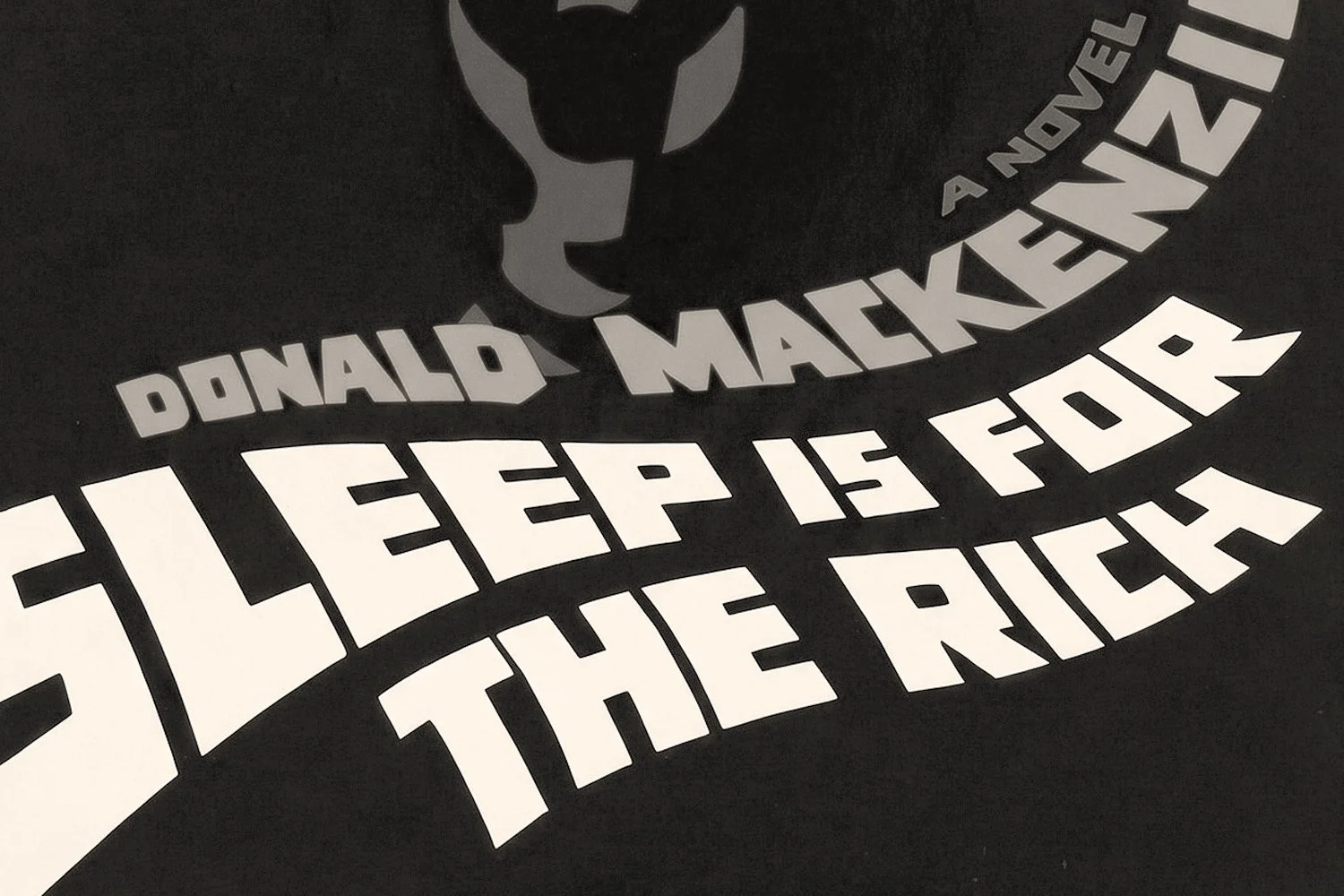
I recently finished reading Sleep is for the Rich (1971), Donald MacKenzie’s sixteenth novel. It was published in the US by Houghton Mifflin and in the UK by Macmillan, both well-respected houses. In this post, I’ll shy away from reviewing the book itself, as I tend to read this author differently than I would a crime yarn by Charles Williams, John D. MacDonald or Jim Thompson. I admit it: I’m not objective in evaluating MacKenzie’s storylines. I’m preoccupied with looking for clues to his criminal or family background and external events that reflect what was happening in his life at the time.
The cover art for the Houghton Mifflin version of Sleep is for the Rich is the work of Tim Gaydos (1941- ). An article published in the October 2007 issue of The Pastel Journal notes that after studying with New York Abstract Expressionist Ippolito at UC Berkley, Gaydos traveled to Italy where worked under the tutelage of Marino Marini. Returning home, he took up freelance book jacket design and illustration in order to support his new family.
Nevertheless, I’ll quickly summarize the plot. Paul Henderson, an accomplished second-story man and master planner of larceny, is at home in London watching television with his seven-year-old daughter, Sophie. His wife—the lousy wife—had run off to Australia years earlier with a water-pump salesman, and Paul hasn’t had a score in over a year. The phone rings. Short of funds, Henderson accepts a risky offer from Henry Chalice, a wealthy and seemingly untouchable criminal associate whom the cops regard with “a kind of frustrated respect.” Chalice and his right-hand man, Crying Eddie, plan to rob ultra-wealthy former Olympic skating champion Marika Bergen and her friends of their jewelry at a gala ball in the fashionable Swiss ski resort of Todtsee. Chalice believes Henderson has the poise and cunning to organize the heist and serve as the team’s front man.
The trio sets the scheme in motion, with multilingual Henderson posing as a millionaire Canadian businessman, Crying Eddie as his butler and Chalice as his chauffeur. Henderson brings Sophie along as a decoy, adding to the story’s tension. Once in Todtsee, the intricate plan runs into trouble: a greasy con man from London recognizes Henderson and wants a payoff to keep quiet; a one-night stand with Bergen’s social secretary, Uschi Regensdorf, turns into blackmail for a cut of the take; and Uschi’s lover, a former-Nazi, snatches Sophie, hoping to claim the stolen jewelry for Uschi and himself. The thieves’ strategy is to release sleeping gas into the ballroom, then don gas masks and strip the slumbering rich of their jewels. Hence the gas masks on the Houghton Mifflin and Macmillan jackets—and the novel’s title. It’s touch and go until the final pages, with our good-guy thieves besting the bad-guy thieves in the end.
It’s touch and go until the final pages, with our good-guy thieves besting the bad-guy thieves in the end.
Reviews of Sleep is for the Rich were mostly positive, and in a letter to MacKenzie dated December 1, 1970, Houghton Mifflin editor Anne Barrett writes:
Henry Volkening [MacKenzie’s literary agent] called me yesterday to say that he thought Sleep is for the Rich the best of all your books. After reading it, I can only concur. Plot structure, characterization, and atmosphere are superb. Besides which, there is an extra ingredient in this one: Paul Henderson’s feeling for Sophie, with which the reader is immediately involved. It is as if you had communicated some of your feeling for your own small daughter into his feeling for his and it makes the story very moving as well as exciting.
Indeed, MacKenzie and his third wife, Estrella de Carvalho—a native of Portugal and 35 years his junior—had welcomed their daughter Kirstie into the world just three years earlier. Like Barrett, I believe the novelist was smitten with his little girl. Occasional comments in his letters to Volkening and, later, to Volkening’s successor, Tim Seldes, suggest as much.
There may be another family connection hidden in Sophie’s character. Henderson mentions his daughter’s full name as Sophia Matilda Henderson. MacKenzie’s maternal great-aunt was Sophia Barr Hendry, and his maternal grandmother was Matilda Barr Duncan. Along with MacKenzie’s mother, Matilda was a part of the South London household in which the future novelist grew up. Whether MacKenzie consciously borrowed their names is impossible to say, but finding the two together in the name of Henderson’s daughter is a remarkable coincidence.
MacKenzie drafted the manuscript—which had a working title of “See How They Run”—while in Albufeira, Portugal that spring and summer with his wife and daughter. He complained in a July 1970 letter to Volkening that the draft needed “…about another week’s work; that’s all and then I shall reread it at leisure. We’re in the 90°s and I must be CRAZY choosing these months and this climate in which to write. Should have waited for winter but you know how it is. I never seem to make enough money.” It’s always about the money with MacKenzie.
Volkening had more serious things to worry about. His wife, Natalie, had died of lung cancer just two months earlier. His longtime assistant, Connie Cunningham, wrote to MacKenzie: “Natalie never smoked, but it was her lungs anyway (is it something in the atmosphere? It seems to be happening so frequently, to so many...).” Prescient woman, that Connie. Henry, unlike Natalie, was a heavy smoker, and he too was suffering from serious lung disease. Surgery in the spring of 1971, shortly after the publication of Sleep is for the Rich, removed a lobe of his lung. He died 18 months later. For more than fifteen years, Volkening had been the ex-con’s literary agent, guiding light and enthusiastic supporter. MacKenzie was in for some adjustments at the New York literary agency.
Donald MacKenzie, photographed by Stephen King. From the jacket of the British edition of Sleep Is for the Rich (Macmillan, 1971).
Sleep is for the Rich is the third and final installment of what might be called the Chalice and Crying Eddie series. The underworld duo also appear in MacKenzie’s earlier Salute from a Dead Man (1966) and Death is a Friend (1967). Both characters are finely drawn, perhaps inspired by real-life personalities MacKenzie admired during his criminal years. The books are enjoyable just for the interplay and bickering, often humorous, between these two underworld characters and the ways they assist each story’s protagonist.
Interestingly, in the earlier novels they support two different protagonists rather than Paul Henderson: Ritchie Duncan—whose surname happens to be MacKenzie’s mother’s maiden name—in Salute, and Bruce Cameron, an aspiring novelist, in Death.
Both characters are Canadian, like Henderson—two more examples of MacKenzie’s recurring use of Canadian protagonists, perhaps intended to reinforce his carefully cultivated identity as a native-born Canuck. We see this beginning in his first book, Occupation: Thief, published in 1955, just a year after his final release from prison. I’ve found no evidence that anyone in the literary establishment ever thought he was anything other than Canadian. So why this incessant need to enlist Canadians in his plots? References to hockey, or secondary characters who played hockey, Canada’s national sport, aren’t unusual either. It raises a question in my mind: did the fiction writer have some chronic psychological need or desire to convince even himself of who he was? Clearly, he had reinvented himself for public consumption. Why the fear that someone might reveal he was … British?
“The British edition of SLEEP is terrible. Badly designed jacket and a slipshod production in general. Since it’s my first book with Macmillan, I’m not too happy.”
“The British edition of SLEEP is terrible. Badly designed jacket and a slipshod production in general,” wrote MacKenzie to his literary agent Henry Volkening in October 1971. I have to agree! It looks like the product of an eighth-grade collage competition, one in which this entry came in last.
Another interesting thing about these Canadian protagonists: they generally have criminal backgrounds, have spent time in prison or, at the very least, have been disowned by their families back in North America. Based on MacKenzie’s first two autobiographical books, you don’t have to read between the lines to understand that he severed any meaningful relationship with his parents and grandparents not long after becoming an adult. And, incidentally, after running through a trust fund his grandmother had established for him.
A few other behind-the-scenes notes on Sleep is for the Rich: MacKenzie didn’t care for the jacket Macmillan chose for the British edition. He wrote to Volkening in October 1971:
The British edition of SLEEP is terrible. Badly designed jacket and a slipshod production in general. Since it’s my first book with Macmillan, I’m not too happy. They have however sold paperback rights to Mayflower for £500. (Note: the £500 fee was equivalent to approximately £9,200, or $12,300 in 2026 dollars).
Mayflower, part of Granada Publishing by the time Macmillan sold the paperback rights, may have considered Henry Chalice the novel’s most marketable character. The publisher certainly gave him top billing: the paperback appeared under the title The Chalice Caper when it came out in 1974.
A few months before MacKenzie’s letter to Volkening, Anne Barrett at Houghton Mifflin also had some good news for the novelist:
A 23,000-word condensation of Sleep is for the Rich was sold to Argosy Magazine and appeared in the January 1972 issue. Note the newsstand pitch at the bottom: “$6.95 BONUS NOVEL—The World’s Foxiest Jewelry Thief Loose Among the Richest Jet-Set Chickens.”
I am happy to inform you that Argosy Magazine is buying the second serial rights for North America, excluding Canada, to a condensation of approximately 23,000 words of Sleep is for the Rich. They will publish it in January, 1972 and will pay a fee of $1,500. A good omen, don’t you think? And a nice bit of cash as well. (Note: the $1,500 fee was equivalent to approximately $12,400 in 2026 dollars).
The irony isn’t lost on me that MacKenzie’s “Canadian brethren” were excluded from this particular North American serial-rights deal, despite the story’s protagonist, Paul Henderson, supposedly being raised in “the Ontario boondocks” of Lamlash, Bruce County, Canada. Lamlash is only about 11 miles from Walkerton, where MacKenzie was arrested for jewelry theft in 1925 during his very brief visit to the Dominion courtesy of the Salvation Army’s teenage migration program. Coincidence? Given MacKenzie’s penchant for drawing on his own criminal past, I doubt it.
Finally, and perhaps as a result of his usual poor-mouthing to Volkening, MacKenzie managed to finagle $200 of his advance on Sleep in October 1971, several months before it was normally payable in mid-December under his contract’s terms. The remaining $1,582.17 of the advance against royalties was paid on schedule in December. Not one to leave any stone unturned, MacKenzie nevertheless questioned Volkening: “How was it that this deal [with Argosy Magazine] went through Houghton and do they take a cut?”
Bibliographical note: The source of some of the information used to compile this article comes from the Russell and Volkening Records, 1940-2008, The New York Public Library Humanities and Social Sciences Library Manuscripts and Archives Division.